Friday, 13 September 2019

Mermaids, Transgender Trends and Seahorses


For what seems like a long time now I’ve been struggling. It’s not a debilitating struggle. And mostly I guess it’s an intellectual thing for me. The word struggling is, perhaps, an overstatement. Maybe tussling is a better word.
Although much of this is intellectual for me, these things can be a real-life all-in thing for others.

At times it’s almost like a sense of despair. Again, maybe an overstatement. Perhaps discouragement is a better fit.

Reading what some people say and of the things some people do.

Seeing how easy it can sometimes be for people resort to fighting with words or fists. How hard some people seem to find it to feel empathy or sympathy.

I’m not immune from this myself.

But mostly, given time, my preference is to work towards consensus – or at least respectful disagreement when consensus seems impossible.

The thoughts have often been triggered by stories that appear in the news. And comments that some people make about the stories.

Mostly the issues are LGBT related.

The intellectual tussling is typified by the kinds of things raised by Transgender Trend .

Transgender Trend is either:

a group of parents based in the UK who are concerned about the current trend to diagnose children as transgender, including the unprecedented number of teenage girls suddenly self-identifying as ‘trans’ (Rapid Onset Gender Dysphoria or ROGD). We are also concerned about legislation which places transgender rights above the right to safety for girls and young women in public toilets and changing rooms along with fairness for girls in sport.
Or is it an organisation that produces a document described by Stonewall as:

a deeply damaging document, packed with factually inaccurate content.
And is Mermaids an organisation that:
is passionate about supporting children, young people, and their families to achieve a happier life in the face of great adversity. We work to raise awareness about gender nonconformity in children and young people amongst professionals and the general public. We campaign for the recognition of gender dysphoria in young people and call for improvements in professional services.
Or is it an organisation that, according to Julian Vigo at Forbes, is involved in:
Pseudo-Scientific Hokum And The Experimentation On Children's Bodies
Is the Trans Health Manifesto making sensible demands in saying:
We demand hormones & blockers are made available over-the-counter and by free prescription upon request. We need free, universal access to safe hormones & blockers at any age, the opportunity to decide our own doses, and universally accessible information on the safety & efficacy of different regimens. We are already taking hormones in this way, so this demand is simply that the danger of doing so is effectively mitigated.
Or is David Wilson making any sense at all in saying:
A silly website I dip into reports this exchange (from Scotland):

([The reporter’s] daughter is seven years old.)
Me: “What do you want to be when you’re older?”
Daughter: “A pink cat!”
Me: “Anything else?”
Daughter: “A mermaid!”

I think that puts into perspective any reliance on a child’s view about gender.
The only way to begin to make any sense of this that I can see is to take each piece of news, each claim and counterclaim on its own merits.
So, I’ve decided to try doing things that way.
Every so often I’m going to open up Google News and try the search term Trans and see what comes up as the first news story. And see what I think of it.

So on 11 September 2019 it’s Seahorse's Trans Dad Criticises Fertility 'Misinformation' Leading To 'De Facto Sterilisation at HUFFPOST.
The article begins with:

Freddy McConnell suggests confusion around fertility options could be leading transgender people to make life-changing decisions they don't need to make.
Freddy has become fairly well known through the recent screening of the documentary “Seahorse: The Dad Who Gave Birth
There’s a review of the documentary at the Telegraph here.
At first, I started typing all this stuff down based simply on what the HUFFPOST article says.
But it wasn’t long before I stopped typing. I spent a while watching the documentary. It's described as:
Trans and pregnant: How one man gave birth to his own baby
Freddy decided to carry his own baby after wanting to start a family, but he faced a highly unusual challenge – he is a gay transgender man. He made the decision after years of soul searching, but nothing could prepare him for the reality of pregnancy.
The documentary raised a whole lot of other questions in my mind.

Now, having done that, here is my take on the HUFFPOST article – and then some thoughts on the documentary.

Freddy was told that the hormone treatment he receives would lead to infertility. This proved to be incorrect.

The question then is should medical practitioners tell the truth when giving people advice about treatment that they will receive?

And the answer to that is: Yes they should.

I don’t know the full details of who said what to Freddy. I hope that the medical practitioner(s) involved told the truth as best they knew it. If that’s the case, then it’s vital that the advice people are given is updated whenever new information becomes available.
I don’t know enough about the human body and the impact that hormonal treatment has upon it to know the whole truth on this. What is clear though, is that testosterone treatment doesn’t render all people that receive it infertile. So that ought to be made clear to a person.
People in medicine are always on a learning curve. Data on the impact of testosterone injections on people is still incomplete. Side-effects will vary from one person to another. So perhaps the advice offered by medicine will always be confusing and potentially conflicting. Nevertheless, it’s vital that advice that isn’t true is given to people.
Freddy is reported as saying:

By paying such little attention to trans people’s wishes to start families and have full lives, and not just the lives that they dictate through this narrow sense of what it is to transition, it is in fact de facto sterilisation
Whenever a trans person is told that their treatment will make it impossible to have children and that belief means that they don’t attempt to have children then I can see that it’s as if they had been sterilised.
However, in Freddy’s case this has, ultimately, proved to not be the case. And, perhaps in no small part thanks to the documentary, it is getting less likely that it will be the case for other people in the future.

And then there is the documentary itself.
This raises a whole lot of different issues.

In the review in the Telegraph (Seahorse: The Dad Who Gave Birth, review: an unflinchingly honest film that doesn't sugarcoat its subject), Sarah Hughes says:

A revealing scene with Esme’s friends [Esme is Freddy’s mother], many of whom had known Freddy since childhood and all of whom were keen to support him, raised many of those tensions – one woman attending the celebration pointed out that Freddy was only able to give birth because of his womb.
Her attempts to articulate that, while not intended to hurt, inflamed the situation to the point of causing Freddy to storm off.

Some viewers will have sighed at that point but there was the sense too that in focusing too much on such debates, on who is right and who wrong, we too easily lose our understanding of the personal stories at stake. For while friends and family might sit around and debate Freddy’s decisions, he himself was clear that his true self, the one that he felt comfortable in, was male and that his journey towards fatherhood was challenging precisely because of that.
And that, for me, is a really important point.
It’s easy to sit at a keyboard and type stuff and focus on what I think might be right or wrong. And to lose touch of the people involved.

The review ends with:

“Is it selfish?” Freddy asked about his decision. “I don’t think so. I think finally people can see who I am – it’s not about being more male making me more valid. It’s just that this is me.”
That simple message lay at the heart of his ultimately rather beautiful journey, a journey that celebrated not only Freddy’s stubborn desires but also the loving support of Esme, who tearfully admitted that she was “in awe of the bravery of my child”.
Emotional and honest to the point of bracing, Seahorse won’t have convinced everyone. But those who were willing to listen were well rewarded. “I had no idea, I was very naïve,” Freddy admitted holding his young son in his arms with a beaming smile. “I think everybody has the potential to feel this way.” That they do was the joy of Finlay’s sensitive, warm-hearted film.
Freddy’s words "It’s just that this is me" speak to me.
The story presented by the documentary does raise questions. Some of them I hadn’t thought about before. Some I’ve thought about a lot.
  • What are the relationships between biological sex, gender, masculinity and femininity?
  • Can a man give birth to a child and be the child’s father?
  • Can someone that is assigned female at birth become male?
  • If a trans woman decided to have a child using her own sperm would she be the child’s mother?
  • Should people refer to me as she, he or they?
  • Should my daughter call me mum or dad?
For some people their answers to these kinds of questions are worked out solely on the basis of:
  • did the person concerned have a penis or a vagina at the time that they were born?
Not so long ago (and sometimes in some places even now) questions like the following have been answered on the same basis – did the person concerned have a penis or a vagina at the time that they were born?

  • How much should a person get paid to do a job?
  • Should this person be allowed to speak in church?
  • Can the person be a Bishop?
  • Is this person allowed to vote in an election?
And yes, I know that they are different kinds of questions. But they illustrate that the significance of words can change over time.
Once upon a time in the country where I live it was correct to say: “A voter is a man”. But these days it isn’t.

I believe that things are changing. The vocabulary that we use isn’t always able to cope well with the daily realities that we face.

For now, I’ll ask just one more question and provide my own answer.

  • As Freddy’s child grows, is Freddy able to support child in the kinds of ways that a father supports his child?
And my answer:
  • I got the feeling that the answer to that question at least is yes.
I know ... a lot more could be said about this – including arguments about how I phrased that last question and answer.

But for now, I’m leaving it at that.

Monday, 26 August 2019

Several Shades of T – Unity within Diversity


A few months ago Anne Yarwood, a close friend of Sally and I asked if I would be editor of the month for the web site that she has produced - The Imagination Acts.
The result was a collection pf pictures and words with a theme of Several Shades of T – Unity within Diversity


It reads as follows - please see The Imagination Acts web site for the pictures.

Several Shades of T – Unity within Diversity
There is a human tendency towards classification and categorisation. To assign labels. To generalise. Male. Female. Straight. Lesbian. Gay. Bi. Trans.
Classification has its uses, but also limitations.
We can use labels to form alliances and to define borders. To stereotype. To marginalise.
It challenges me that I sometimes construct borderlines as a way of self defence and preservation and fail to see the bigger picture. It is possible to value the things that hold us together. To uphold each other. And to celebrate our distinctiveness.
After more than half a lifetime of denial I gave up a battle with myself and began to accept myself as the person that I am. This came with the label “trans”. As time passes, I need to regularly remind myself of the inadequacy of this label. To see that no label defines who I am. Or who you are. There is a much bigger story to your life and to mine.

The Borderline
Cos what is love – a word, the feeling of you ?
Something we dream or the things that we do ?
And who am I – these thoughts, this feeling, my views
A fragile form or a dreamer like you ?
Are we so different, defined ?
Where is the borderline ?

When we are like water, like trees
We have a name, an illusion of identity
Of boundaries, of borderlines
But my dreams are yours and your fears are mine
I hope we wake up from this dream of being different, defined
When we are only space and time
Emily Maguire (https://emilymaguire.com/biog/) is a singer-song writer, poet and composer. The International Society for Bipolar Disorders awarded her the 2019 Mogens Schou Award for Public Service and Advocacy.
Several Shades of T
The storyline that I’m thinking of opened with L and G.
After a while they were joined by B.
And then T.
LGBT.
More recently a large selection of the rest of the alphabet has joined in. Some of them more than once.
LGBTQQIAAPOG …
Lesbian. Gay. Bisexual. Trans. Queer. Questioning. Intersex. Asexual. Ally. Pansexual. Other. Genderfluid. …
Sometimes the newcomers all get represented by just a +.
LGBT+.
But the story isn’t about the alphabet.
It’s about people.
It began long before the alphabet got involved.
And like all stories about people, whilst there are still people the story will continue.
Some people are intimately involved in the story. Others are more on the periphery. We can all be involved. In some ways, we all are involved.
There is a truth in that different people read the same story in different ways.
Some see a collection of different letters of the alphabet. They don’t identify with any of the letters. The story is a threat. An anathema. An abomination. They want to put an end to it. But the story is about people and not the alphabet. Ending it involves blood. And even then, whilst there are people the story will continue.
Some claim a letter as their own. They hold it close. They know it and understand it. Looking at the other letters they aren’t so sure. Not all letters are equal. Some of them are frauds. Dangerous. Threatening. They need to be restricted. Controlled.
Some don’t consciously read the story at all. But by words, silences, actions and inactions they take part.
Over the years I’ve come across people that read the story in these ways. And of people that read it in many, many other ways.
My own take on it has changed. Is still changing.
I’ve discovered that I have letters in this story.
I know other people that have the same letters.
But sharing the same letters in a story doesn’t make us the same people. We have our own thoughts, feelings, preferences. And we can even read the same story in different ways.
I know other people with other letters.
But I know no one for whom a letter, or even an entire alphabet, provides an adequate definition of who they are.
In all of this I identify as T and G – that is a Trans person that is Genderfluid.
So, what does that mean? And does it matter.
The term trans is often defined as something like this: an umbrella term for all people who cross traditional gender boundaries – whether that is permanently or periodically (https://www.nhs.uk/livewell/transhealth/documents/livingmylife.pdf.
And then there’s the term genderfluid. You could say that genderfluid individuals have different gender identities at different times. A genderfluid individual’s gender identity could be multiple genders at once and then switch to none at all, or move between single gender identities, or some other combination therein. For some genderfluid people, these changes happen as often as several times a day and for others, monthly, or less often. Some genderfluid people regularly move between only a few specific genders, perhaps as few as two (which could also fit under the label bigender), whereas other genderfluid people never know what they’ll feel like next (See HERE  – wiki/Genderfluid).
However, the definitions certainly have their limitations.
I’ve come across some trans people who don’t like to stand under the same umbrella as other trans people. Which might add another letter to the story to accommodate them.
Some people don’t believe that T has the right to be included along with LG or B.
Sometimes, people begin to talk trans and then focus more upon pronouns, lavatories, changing rooms and restrooms than they do on people.
Sometimes people say and do things that are much worse.
Trans people face many challenges. All people face many challenges.
What special rights should trans people have?
Perhaps nothing more special than things that I believe should be given to all people.
Things like kindness, compassion, respect and understanding.
Ultimately, what every trans person that I know wishes for, is to simply be themselves.
It’s not about special treatment or privileges.
Of course, that’s the beginning of a story more than it is the end of one. Pronouns, restrooms, changing rooms and safe spaces matter.
Safety matters.
People are capable of pretending to be someone that they are not.
There are challenges.
But in working out solutions to these challenges let’s remember that behind every acronym and label there are real people. That even when people share the same label, they are different from each other. That there is no single voice that fully represents any label. That it is possible to disagree with someone else and yet to do that with respect and kindness. That there are times when the ability to reach a compromise is a strength. That it is better to listen to and talk with each other than it is to write about each other. That whispers sometimes speak more loudly than yells.
The acronyms are complicated. People are complex. But there is something special when people that pick up different labels are able to move beyond the things that make them different. To see diversity as a thing that can enrich and strengthen rather than something that weakens and destroys.
And of course, just like you, I have lots of other letters of the alphabet in lots of other stories. And we’re all involved in each of these stories in one way or another. Some stories touch us closely. Others seem to be more distant. But we are involved. What we say and do has an effect. Our inactions and silences also have an effect. And all the separate stories are, in reality, parts of a single bigger story.
Martin Niemöller (first-they-came-for-the-socialists) is remembered for saying:
First they came for the socialists, and I did not speak out – because I was not a socialist.
Then they came for the trade unionists, and I did not speak out – because I was not a trade unionist.
Then they came for the Jews, and I did not speak out – because I was not a Jew.
Then they came for me – and there was no one left to speak for me.

And so, even though I am not L or G or B, I still speak out. We are all neighbours (www.biblegateway.com/passage).
Last year I discovered the music of Emily Maguire (https://emilymaguire.com/ ) and was especially touched when listening to a song of hers called The Borderline which speaks to me of the way it can be so easy to concentrate on things that divide us rather than the things that hold us together. You can listen to it  HERE  and  HERE.
The words are:
The Borderline
[E.Maguire]

Where is the borderline
The boundary between your tribe and mine
Are we the rain, the river, the cloud and the sea
If we are like water then which drop is me

And what is time – the fast blink of an eye
A circle so vast that we think it’s a line
And what is space – the air, the silence we breathe
A place of our own and the ghosts we don’t see
Is it the boundary, the borderline
Between you and I, your mind and mine

Is fire the spark, the fuel, the air or the heat
The smoke in your eyes or the ash at your feet
Are trees the root, the branch, the wood or the leaves
The forest we burn or the broom that we keep
Beneath the stairs, the stars, the space in a jar. The air outside is that where you are
Is that the borderline, the boundary
Between you and I, between your tribe and mine

But isn’t fear the dark shadow of hope
The things that we want and the things that we don’t
And so we cling and close the eyes that look in,
The soul we don’t see under the skin
Cos that’s a boundary, the borderline
Between you and I, between your tribe and mine

But we both were born and both will die
And in between will doubt and dream
Of a better life than life before
A meaning or a reason for
This feeling of being different, defined
When we are only dreaming of boundaries and borderlines
I hope we wake up

Cos what is love – a word, the feeling of you
Something we dream or the things that we do
And who am I – these thoughts, this feeling, my views
A fragile form or a dreamer like you
Are we so different, defined
Where is the borderline?

When we are like water, like trees
We have a name, an illusion of identity
Of boundaries, of borderlines
But my dreams are yours and your fears are mine
I hope we wake up from this dream of being different, defined
When we are only space and time


And yes, I too hope that we wake up.


Thursday, 15 August 2019

Harrogate revisited - Q's and Ps, Stout and Wasps, Breaking Free, Art, Ilkley Moor and Niel Diaomond

2018 was Eastbourne.

2017 was Sparkle.

2016 was Eastbourne.

2015 was Bournemouth.

Way back in 2014 it was Harrogate  as it was in 2013.

August 2019 provides an opportunity for Harrogate revisited.

Back in 2013 I lured Tina into the The Winter Gardens and we received Wolf Whistles. In 2014 Tina lorn'd hoo te speak Geordie, courtesy of Malcolm. 

Though, maybe it would be more accurate to say, Tina tried te worrk oot what a Geordie wez saying.

 The Harrogate weekend is organised by Kay and Irene West. 

It usually happens twice a year at the Cairn Hotel in – you guessed it – Harrogate. 

This is Harrogate weekend number  13th.

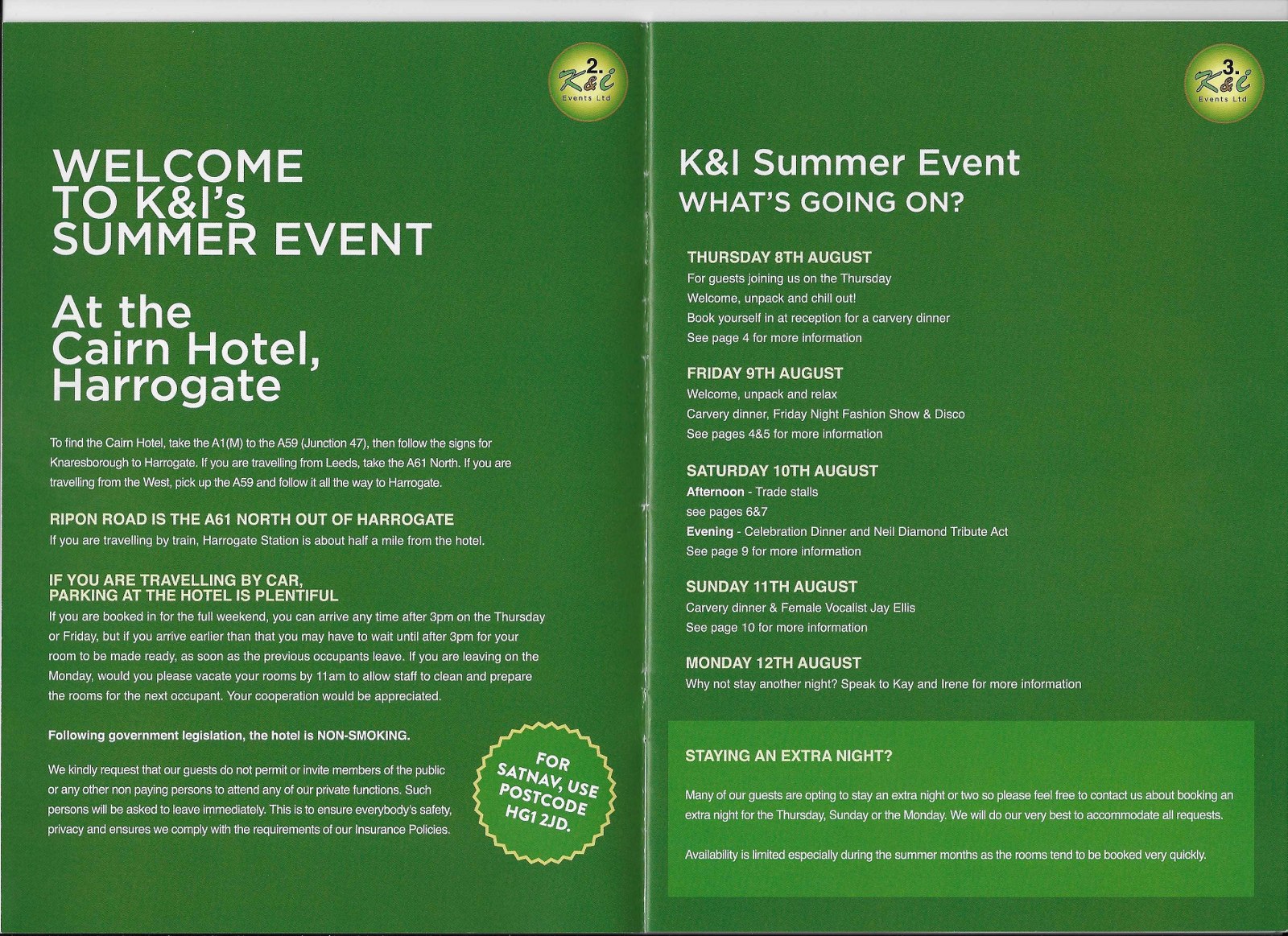
This is the plan for the weekend:


And here’s how it went for Andrea and Tina in 2019.

Andrea spends a surprisingly long time on the evening of Wednesday August 7th packing two suitcases. 

Having decided that one suitcase wasn’t going to be quite enough she succumbs to the temptation to actually try to fill them both. 

It has something to do with the six pairs of shoes and all that makeup.

It’s strange how this girl takes twice as much stuff for 4 days in Harrogate as the guy took for a four-week trip to New Zealand. 

Post-packing there is the nail polish. Two coats of Barry M Siren (823) with a pre basecoat and post topcoat thrown in.

Come Thursday morning it’s time to make up, even though she hasn’t fallen out with anyone. All in all, an unrushed hour and fifteen minutes and she’s ready.

Tina arrives and makes up, without falling out, and changes. Then they are on the road.

A brief fuel stop, and the trip begins.

At various places the girls say hello to some of Eddie’s girls.

At Watford Gap, that icon of British motoring history, it’s time for a visit to the conveniences and a cup of coffee. 

Until just a few moments ago I never knew that there is a village named Watford as well as a town named Watford – and, of course, a Gap named Watford.

A while later, somewhere along the A1, Andrea needs to spend another penny 

Relief is soon in sight as an Esso petrol station complete with Burger King, Gregg's and the Doncaster Travelodge appear on the horizon. 


The car park is out back. 

Tina stretches her legs.

“I’ll be back in a minute”. Andrea heads towards Greggs and Burger King and steps inside. 

On the other side of the door Andrea realises that she’s been a bit over optimistic. 

There is a p q – or should that be a q to p? 

Andrea comes in at number five. 


The door to the right apologises.


Ahead there’s another door, introducing itself as:

The line of ladies waits patiently. 

Andrea slowly and quietly steps from one foot to the other. 


Two men walk past the line, through the door and turn right. 

The resulting kerfuffle abates as the leader of the line points out that that through the main door and to the right, the door is:


To the left is:


And between the two:

No wonder there is a Q to P.

The leftmost door opens.

The line shrinks by one. 

At least the part of the line in front of Andrea. 

Behind, it’s grown by two. 

Two men exit the door on the right.

Quietness.

A whisper. “Is it empty?”

“Go and have a look.”

She goes.

And returns.


"No it isn't empty."

The leftmost door opens, and the line shrinks again.

A man exits from the right.

A girl takes a chance and heads right.

The Gents temporarily becomes a Ladies.

Andrea smiles at the instant transition.

The line moves forwards.

A little over twenty minutes after the infamous “I’ll be back in a minute”, a relieved Andrea emerges, and the journey continues.

At the Cairn there is plenty of room in the car park. 


Check-in is painless. 

Kay and Irene greet the newcomers who aren’t newbies, knowing who they are without having to ask.

After unpacking it’s a Malthouse and a Black Sheep in the bar.


Dinner, conversations and sleep.

The weather forecast for the weekend is somewhat grim.

But Friday starts of dry. Providing an opportunity to walk into town to stock up on supplies of foundation and liner at Superdrug. 

And a predictable detour to the Winter Gardens for a tipple of stout.


A wasp says hello to Tina and decides to go for a swim in her drink.

Wasps seem to have a thing for Tina.

It was only a week or so ago at Surrey Swans that another wasp did exactly the same thing.
The wasp sips stout and swims as Tina goes off in search of a teaspoon.

Things don't end well for the wasp.

Back at the Cairn there’s opportunity to relax and chat with folks. 


We talk about where we are at. 

Where we have been. 

Where we are headed. 

The universe.

The second law of thermodynamics.

Religion. 

Deuteronomy (as in the Bible rather than the practical cat).

Politics. 

Indigo Girls.

Emily Maguire.

Jacob Rees-Mogg Esq. 

Prime Minister Johnson. 

President Trump.

And a long, long list of other things.

Not everyone agrees with everyone else. 

But there's certainly more makeup than there is breakup in the air.

Then there's dinner

Followed by the fashion show,courtesy of M & Co) and disco. 

The star model is Kay, who enters stage left complete with a Vax vacuum cleaner and a rendition of “I want to break free”. 

Fantastic!

Saturday starts off dry but is going to get wet. 

OK Google.


And it’s a trip to the Mercer Art Gallery.


Tina, Andrea and the occupants of another car spend a surprisingly long time to work how much it costs to park a car on Crescent Gardens.
They then find out about William Powell Frith: The People’s Painter - with more about him here and here.


Tina and Andrea have never heard of him before, but both enjoyed the exhibition very much.


The rain begins. 

Tina borrows a red National Trust brolly.

There’s a chance to find out all about:  Yorkshire! Achievement, Grit and Controversy

As it says 

“From Jodie Whittaker the new Doctor Who, to the notorious Gunpowder Plot conspirator Guy Fawkes, discover the faces that have helped create the reputation of Yorkshire. Who would you include to demonstrate the county’s reputation?” 

Michael Parkinson, David Hockney, Arthur Scargill, Alan Bennett, Patrick Stewart, Guy Fawkes, Nicola Adams, Judi Dench and Geoffrey Boycott are amongst the many that get a mention.

Hidden amongst the exhibits are little gems such as “Put wood inth ‘ole” and “On Ilkla Moor Baht’at”. 

And here’s the song . With a fair few “On Ilkla Mooar baht 'at’s” omitted.

Wheear 'ast tha bin sin' ah saw thee, ah saw thee?
On Ilkla Mooar baht 'at
Wheear 'ast tha bin sin' ah saw thee, ah saw thee?
Wheear 'ast tha bin sin' ah saw thee?
On Ilkla Mooar baht 'at

Tha's been a cooartin' Mary Jane

Tha's bahn' to catch thy deeath o' cowd

Then us'll ha' to bury thee

Then t'worms'll come an' eyt thee oop

Then t'ducks'll come an' eyt up t'worms

Then us'll go an' eyt up t'ducks

Then us'll all ha' etten thee

That's wheear we get us ooan back

If 2014 was the year of the Geordie, then 2019 is surely the year of the Yorkie.

Andrea wonders if they still sing this in music lessons at schools.

Back at the Cairn there’s a chance to chat and get ready for dinner.


After dinner it’s Neil Diamond. 

Andrea takes a break and phones home to say hello to Sally.

“Does he sound a lot like Neil Diamond?”
“Maybe. But I have no idea what Neil Diamond sounds like.”

Tina confesses to being not so sure either.

It’s a pleasant evening. 

Oddly, the best part from a dancing perspective anyways, is a series of non-Neil Diamond songs sung in a Neil Diamond style.

Having danced the night away with swaying señorita’s (or, in the case of T & A perhaps that should be señiorita’s) its off to sleep ready for breakfast and the journey home on Sunday

All in all, a great weekend. 

Tuesday, 13 August 2019

Café Rouge

Back on July 22, I spent a lovely evening with Tina, Julia, Suzie and Chloe at Café Rouge in Windsor. It's a nice place, the food is good and the staff are great.

And here we are just before setting off (Suzie, Chloe, Julia, Andrea, Tina).


And at Café Rouge:


As always it was great to see everyone and catch up with what's happening.

On Thursday 1st August, Suzie, Chloe, Nikki and myself paid another visit and had a great time together and an excellent meal.

Saturday, 22 June 2019

Shades of life, cats and bags

The past few months have seen quite a mix of the different shades of life.

Last October when Sally and I were on holiday my brother phoned and said that he'd been diagnosed with throat cancer.

On getting back home and then to work, a colleague and close friend told me that he'd just been diagnosed with stomach cancer.

My brother began radiotherapy.

My friend began chemotherapy.

In February Sally and I spent a month in New Zealand visiting our youngest daughter Katie who's been living and working there since early 2018. That was wonderful.

The chemotherapy was ineffective for me friend, so there was then immunotherapy. He passed away at the end of May. His funeral took place a few days ago.

The radiotherapy was ineffective for my brother. He had a laryngectomy just a few days after my friends passing. Thankfully, that seems to have gone well and he's recovering well. It is, though, a life-changing procedure.

Last weekend Sally and I celebrated a premature ruby wedding anniversary and we had a party for friends and family. The real thing is on July 27th, but Katie was back in the UK for a few weeks, so we took the opportunity of celebrating it at a time when she was around.

The was a time of joy. Sally said a few words. She mentioned the challenges of married life and also how my "coming out as trans" had helped us grow closer rather than pushed us apart. Not everyone there had heard of Andrea - though these days we're no sure who does know and who doesn't. It's not a secret, but no public announcements had been made before. So, the cat is now completely out of the bag. Thinking about it, I'm sure that it's better both for the cat and for me. Katie also said some lovely things, as did Sally's brother.

2018 and 2019 have included a mix of fear and hope, sadness and joy. I guess, that's what life is.

Friday, 17 May 2019

LGBT Lessons?

The headline reads LGBT school lessons protests spread nationwide (https://www.bbc.co.uk/news/uk-england-48294017).

The picture with the article is this:


People are reported as saying things like:
  • We are not homophobic people
  • All we are concerned [about] is we are having our children come home with material that contradicts our moral values
  • It's not about gay lesbian rights and equality. This is purely about proselytising a homosexual way of life to children
  • They want to convert you, they want to convert your morality and that's just wrong
So, what is the truth?

The UK government view is discussed here:

The official Department for Education document: Relationships Education, Relationships and Sex Education (RSE) and Health Education Draft statutory guidance for governing bodies, proprietors, head teachers, principals, senior leadership teams, teachers is here: https://assets.publishing.service.gov.uk/government/uploads/system/uploads/attachment_data/file/781150/Draft_guidance_Relationships_Education__Relationships_and_Sex_Education__RSE__and_Health_Education2.pdf

Of Relationships Education it says that: By the end of primary school, pupils should know:

  • that families are important for children growing up because they can give love, security and stability.
  • the characteristics of healthy family life, commitment to each other, including in times of difficulty, protection and care for children and other family members, the importance of spending time together and sharing each other’s lives.
  • that others’ families, either in school or in the wider world, sometimes look different from their family, but that they should respect those differences and know that other children’s families are also characterised by love and care.
  • that stable, caring relationships, which may be of different types, are at the heart of happy families, and are important for children’s security as they grow up.
  • that marriage13 represents a formal and legally recognised commitment of two people to each other which is intended to be lifelong.
  • how to recognise if family relationships are making them feel unhappy or unsafe, and how to seek help or advice from others if needed.
  • how important friendships are in making us feel happy and secure, and how people choose and make friends.
  • the characteristics of friendships, including mutual respect, truthfulness, trustworthiness, loyalty, kindness, generosity, trust, sharing interests and experiences and support with problems and difficulties.
  • that healthy friendships are positive and welcoming towards others, and do not make others feel lonely or excluded.
  • that most friendships have ups and downs, and that these can often be worked through so that the friendship is repaired or even strengthened, and that resorting to violence is never right.
  • how to recognise who to trust and who not to trust, how to judge when a friendship is making them feel unhappy or uncomfortable, managing conflict, how to manage these situations and how to seek help or advice from others, if needed.
  • the importance of respecting others, even when they are very different from them (for example, physically, in character, personality or backgrounds), or make different choices or have different preferences or beliefs.
  • practical steps they can take in a range of different contexts to improve or support respectful relationships.
  • the conventions of courtesy and manners.
  • the importance of self-respect and how this links to their own happiness.
  • that in school and in wider society they can expect to be treated with respect by others, and that in turn they should show due respect to others, including those in positions of authority.
  • about different types of bullying (including cyberbullying), the impact of bullying, responsibilities of bystanders (primarily reporting bullying to an adult) and how to get help.
  • what a stereotype is, and how stereotypes can be unfair, negative or destructive.
  • the importance of permission-seeking and giving in relationships with friends, peers and adults.
  • that people sometimes behave differently online, including by pretending to be someone they are not.
  • that the same principles apply to online relationships as to face-to-face relationships, including the importance of respect for others online including when we are anonymous.
  • the rules and principles for keeping safe online, how to recognise risks, harmful content and contact, and how to report them.
  • how to critically consider their online friendships and sources of information including awareness of the risks associated with people they have never met.
  • how information and data is shared and used online.
  • what sorts of boundaries are appropriate in friendships with peers and others (including in a digital context).
  • about the concept of privacy and the implications of it for both children and adults; including that it is not always right to keep secrets if they relate to being safe.
  • that each person’s body belongs to them, and the differences between appropriate and inappropriate or unsafe physical, and other, contact.
  • how to respond safely and appropriately to adults they may encounter (in all contexts, including online) whom they do not know.
  • how to recognise and report feelings of being unsafe or feeling bad about any adult.
  • how to ask for advice or help for themselves or others, and to keep trying until they are heard,
  • how to report concerns or abuse, and the vocabulary and confidence needed to do so.
  • where to get advice e.g. family, school and/or other sources.

On the subject of: Lesbian, Gay, Bisexual and Transgender (LGBT) the document says:

  • In teaching Relationships Education and RSE, schools should ensure that the needs of all pupils are appropriately met, and that all pupils understand the importance of equality and respect. Schools must ensure that they comply with the relevant provisions of the Equality Act 2010, (please see The Equality Act 2010 and schools: Departmental advice), under which sexual orientation and gender reassignment are amongst the protected characteristics.
  • Schools should ensure that all of their teaching is sensitive and age appropriate in approach and content. At the point at which schools consider it appropriate to teach their pupils about LGBT, they should ensure that this content is fully integrated into their programmes of study for this area of the curriculum rather than delivered as a standalone unit or lesson. Schools are free to determine how they do this, and we expect all pupils to have been taught LGBT content at a timely point as part of this area of the curriculum.

Looking at this list I find it really difficult as to why any parent should be afraid that their child would know these things.


It doesn't suggest anywhere in the document that schools should teach pupils that they should become Lesbian, Gay, Bisexual or Trans. It speaks of awareness and respect for people that may be different from you.


Of Relationships and Sex Education (RSE) it says that by the end of secondary school pupils should know:

  • that there are different types of committed, stable relationships.
  • how these relationships might contribute to human happiness and their importance for bringing up children.
  • what marriage is, including their legal status e.g. that marriage carries legal rights and protections not available to couples who are cohabiting or who have married, for example, in an unregistered religious ceremony.
  • why marriage is an important relationship choice for many couples and why it must be freely entered into.
  • the characteristics and legal status of other types of long-term relationships.
  • the roles and responsibilities of parents with respect to raising of children, including the characteristics of successful parenting.
  • how to: determine whether other children, adults or sources of information are trustworthy: judge when a family, friend, intimate or other relationship is unsafe (and to recognise this in others’ relationships); and, how to seek help
  • the characteristics of positive and healthy friendships (in all contexts, including online) including: trust, respect, honesty, kindness, generosity, boundaries, privacy, consent and the management of conflict, reconciliation and ending relationships. This includes different (non-sexual) types of relationship.
  • practical steps they can take in a range of different contexts to improve or support respectful relationships.
  • how stereotypes, in particular stereotypes based on sex, gender, race, religion, sexual orientation or disability, can cause damage (e.g. how they might normalise non-consensual behaviour or encourage prejudice).
  • that in school and in wider society they can expect to be treated with respect by others, and that in turn they should show due respect to others, including people in positions of authority and due tolerance of other people’s beliefs.
  • about different types of bullying (including cyberbullying), the impact of bullying, responsibilities of bystanders to report bullying and how and where to get help.
  • that some types of behaviour within relationships are criminal, including violent behaviour and coercive control.
  • what constitutes sexual harassment and sexual violence and why these are always unacceptable.
  • the legal rights and responsibilities regarding equality (particularly with reference to the protected characteristics as defined in the Equality Act 2010) and that everyone is unique and equal
  • their rights, responsibilities and opportunities online, including that the same expectations of behaviour apply in all contexts, including online.
  • about online risks, including that any material someone provides to another has the potential to be shared online and the difficulty of removing potentially compromising material placed online.
  • not to provide material to others that they would not want shared further and not to share personal material which is sent to them.
  • what to do and where to get support to report material or manage issues online.
  • the impact of viewing harmful content.
  • that specifically sexually explicit material e.g. pornography presents a distorted picture of sexual behaviours, can damage the way people see themselves in relation to others and negatively affect how they behave towards sexual partners.
  • that sharing and viewing indecent images of children (including those created by children) is a criminal offence which carries severe penalties including jail.
  • how information and data is generated, collected, shared and used online
  • the concepts of, and laws relating to, sexual consent, sexual exploitation, abuse, grooming, coercion, harassment, rape, domestic abuse, forced marriage, honour-based violence and FGM, and how these can affect current and future relationships.
  • how people can actively communicate and recognise consent from others, including sexual consent, and how and when consent can be withdrawn (in all contexts, including online).
  • how to recognise the characteristics and positive aspects of healthy one-to-one intimate relationships, which include mutual respect, consent, loyalty, trust, shared interests and outlook, sex and friendship.
  • that all aspects of health can be affected by choices they make in sex and relationships, positively or negatively, e.g. physical, emotional, mental, sexual and reproductive health and wellbeing.
  • the facts about reproductive health, including fertility and the potential impact of lifestyle on fertility for men and women.
  • that there are a range of strategies for identifying and managing sexual pressure, including understanding peer pressure, resisting pressure and not pressurising others.
  • that they have a choice to delay sex or to enjoy intimacy without sex.
  • the facts about the full range of contraceptive choices, efficacy and options available.
  • the facts around pregnancy including miscarriage.
  • that there are choices in relation to pregnancy (with medically and legally accurate, impartial information on all options, including keeping the baby, adoption, abortion and where to get further help).
  • how the different sexually transmitted infections (STIs), including HIV/AIDs, are transmitted, how risk can be reduced through safer sex (including through condom use) and the importance of and facts about testing.
  • about the prevalence of some STIs, the impact they can have on those who contract them and key facts about treatment.
  • how the use of alcohol and drugs can lead to risky sexual behaviour.
  • how to get further advice, including how and where to access confidential sexual and reproductive health advice and treatment.

The document also makes clear:

  • A good understanding of pupils’ faith backgrounds and positive relationships between the school and local faith communities help to create a constructive context for the teaching of these subjects.
  • In all schools, when teaching these subjects, the religious background of all pupils must be taken into account when planning teaching, so that the topics that are included in the core content in this guidance are appropriately handled. Schools must ensure they comply with the relevant provisions of the Equality Act 2010, under which religion or belief are amongst the protected characteristics.
  • All schools may teach about faith perspectives. In particular, schools with a religious character may teach the distinctive faith perspective on relationships, and balanced debate may take place about issues that are seen as contentious. For example, DRAFT 13 the school may wish to reflect on faith teachings about certain topics as well as how their faith institutions may support people in matters of relationships and sex.
  • In all schools, teaching should reflect the law (including the Equality Act 2010) as it applies to relationships, so that young people clearly understand what the law allows and does not allow, and the wider legal implications of decisions they may make.

Again, I find it really difficult as to why any parent should be afraid that their child would know these things. In fact, it worries me that some parents prefer that their children shouldn't know.


The above involved a lot of copying and pasting. But I did read it all as well.


There's a lot of other stuff in the document, please read it.


The truth is no one is proposing that there should be LGBT lessons.


The proposal is that in the wider context of relationships that children should be encouraged to treat other people with respect - even L people, G people, B people and T people.


So in the end I have no opinion as to whether or not the protesters are homophobic. But I'm pretty sure that they are either ill-informed or, what would be even worse, they are afraid that their children should be taught some of the things that are listed above.


Wednesday, 23 January 2019

TRANSlation - a trans film for cis people - Café and Documentaries Revisited

Back here I mentioned a visit to  Café and the filming of a documentary.

Since then there's been a little more of the same with differences.

On January 13th I spent a lovely evening at Café Rouge in Windsor with Chloe, Susie, Julia and Tina. Here we are:


The documentary that I mentioned has been completed. It's named TRANSlation - a trans film for cis people and is here:


I think it makes the point well, that things are moving, but that there is still a long way to go.

Thank you Harri, Alex, Elisha, Evie, Nate and Terrel for all the time that you put into this.

And thank you Alice, Laura, Adele, Lewis, Anabel, Summer and Avery for the things you shared.